The Great Wall of China: A Remarkable Engineering Achievement
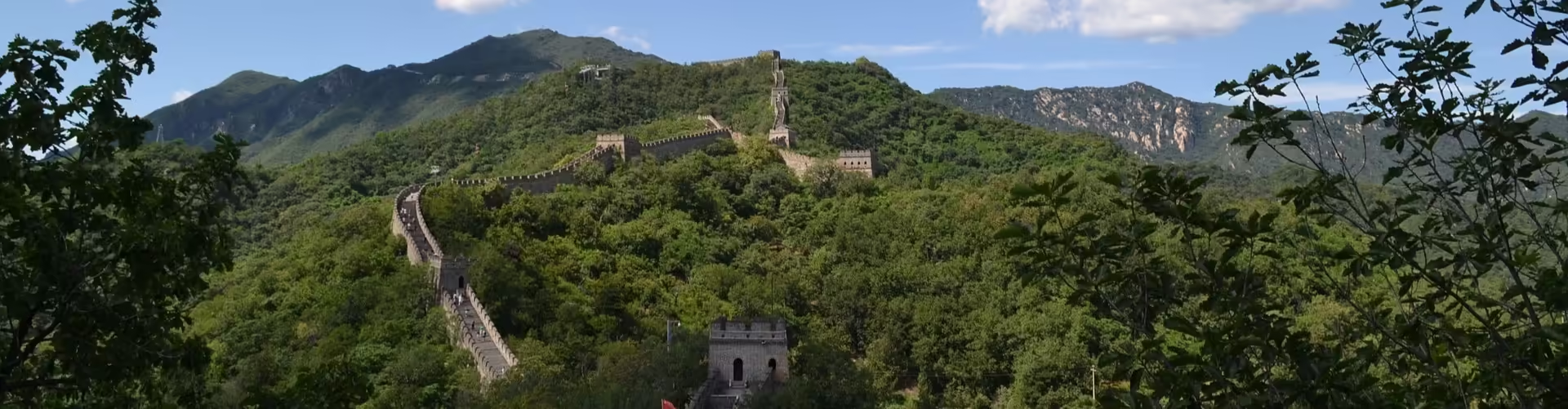
The Great Wall, often referred to as the Great Wall of China, is not only the most magnificent ancient military defense project in Chinese history but also a symbol of the Chinese nation and a treasure among the world's cultural heritage sites.
You may have witnessed the grandeur of the Great Wall of China in countless promotional videos, but no camera can ever fully capture its true scale. Only when you set foot upon the Wall yourself will you truly grasp its majesty.
The purpose of building the Great Wall was to resist foreign invasions and use cliffs to block enemy attacks. In ancient times, without advanced weapons, the Great Wall was a very effective defensive structure. Various states built Great Walls in their border areas to defend against foreign invasions. Later, afterQin Shi Huang unified these states (Qin Shi Huang unified the six states), he connected the Great Walls of different states, forming the Great Wall of China spanning 10,000 li.
Most people will think of the Badaling Great Wall in Beijing when mentioning the Great Wall of China. The Badaling Great Wall is only part of the 10,000-li-long Great Wall of China. In the Beijing area, there are also theMutianyu Great Wall, Simatai Great Wall, and Jiankou Great Wall. In other regions of China, there are "Jinshanling Great Wall (Chengde, Hebei), Jiayuguan Great Wall (Gansu), Shanhaiguan Great Wall (Qinhuangdao, Hebei), Yumen Pass Great Wall (Xinzhou, Shanxi), Datong Great Wall (Shanxi), and Qingshui River Ming Great Wall (Inner Mongolia)".
First, we recommend visiting the Badaling Great Wall; secondly, we recommend visiting the Mutianyu Great Wall.
Legends of the Great Wall of China
There are two famous legends about the Great Wall of China to share with you: The first story is "Beacon Fires That Fooled the Lords", and the other is "Meng Jiangnü Weeps for the Great Wall".
The Legend of Beacon Fires That Fooled the Lords
According to legend, during the Western Zhou Dynasty (781–771 BCE), there was an emperor named King You of Zhou (the last ruler of the Western Zhou). He was obsessed with beauty and neglected his duties, leading to the decline of the state and widespread suffering among the people.
He had a concubine named Bao Si, known for her cold and aloof demeanor, who had never smiled. To make her laugh, King You ordered the beacon towers (used in ancient times to signal foreign invasions) to be lit. When officials and soldiers saw the fires, they rushed to the palace to defend the king, only to discover that there was no actual invasion—it was merely the king playing a cruel joke on them.
While King You and Concubine Bao Si were drinking and reveling on the city wall, they watched the officials and soldiers leave in disarray. At this sight, Bao Si finally smiled.
This story illustrates King You’s moral corruption and selfishness. He valued his pleasures over the safety and security of his country.
The Legend of Meng Jiangnü Weeping for the Great Wall
During the Qin Dynasty, the emperor conscripted laborers to build the Great Wall. Meng Jiangnü’s husband, Fan Xiliang, died of exhaustion during the construction and was buried under the Great Wall. When Meng Jiangnü learned of his death, she was heartbroken and wept for three days and nights at the Great Wall. Her sorrow moved heaven, causing the Great Wall to collapse and reveal her husband’s (Fan Xiliang) body.
This story depicts the hardships of peasants during the Qin Dynasty and celebrates Meng Jiangnü’s devotion to love and loyalty.
Explore the diverse sections of the Great Wall found across China's various regions
Badaling Great Wall(八达岭长城)
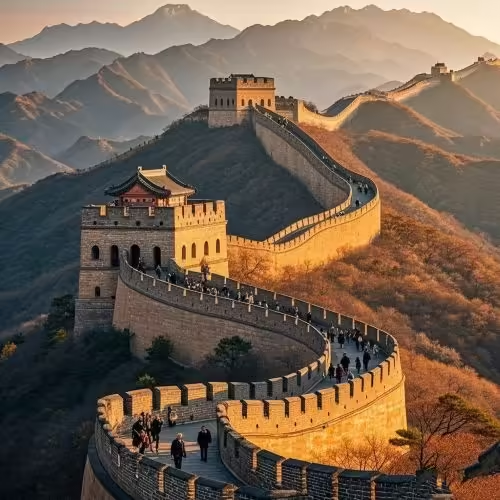
The Badaling Great Wall is the best-preserved section of the Great Wall of China, with well-developed facilities. It is rated as a 5A-level scenic spot in China and is popular among tourists. The 2022 Winter Olympic Torch Relay passed through the Badaling Great Wall.
The Badaling Great Wall was first constructed during the Warring States Period, expanded during the Qin Dynasty, extensively renovated in the Ming Dynasty, and later restored in the Qing Dynasty. The total length is 23.27 kilometers, with approximately 3.74 kilometers open to visitors.
Main attractions of the Badaling Great Wall:
Hero Slope (the highest point of the Badaling Great Wall, at ~868 meters elevation): A stone tablet inscribed with Chairman Mao Zedong’s quote: “He who has not climbed the Great Wall is not a true hero.”
Looking-at-Beijing Rock (a granite rock, 15 meters long and 1 meter high): Inscribed with the phrase “望京石” (Looking-at-Beijing Rock). Legend says ancient soldiers used to gaze toward the capital from here.
Q in Sound Gorge (a river where water striking rocks produces a sound resembling a musical instrument): A stone here bears the inscription “Five Noble Heads Qin Sound Gorge.
Heav enly Peril Inscription (a stone etched with the words “天险” (Heavenly Peril)): Said to have been written by a local official named Tong En during the 15th year of the Daoguang era (Qing Dynasty).
The Great Wall Museum (a museum dedicated to the history of the Badaling Great Wall, named by former President Jiang Zemin).
Location(To Badaling Great Wall): The Badaling Great Wall is located at the northern entrance of the ancient Guandong Road on Jundushan Mountain, Yanqing District, Beijing, approximately 60 kilometers from the center of Beijing City.
Opening Hours: Peak Season (April 1 - October 31): 6:30 AM - 4:30 PM, Off-Season (November 1 - March 31): 7:30 AM - 4:00 PM.
Ticket Prices: Peak Season: ~40 CNY per person, Off-Season: ~35 CNY per person (Additional fees apply for cable cars and other attractions).In 2025, a Night Great Wall Tour project was launched:Price: 198 CNY per person (298 CNY during holidays).
Open Dates: April 30 - October 7, 2025.
Check-in Time: 6:30 PM - 9:00 PM.
Closure: 9:30 PM (visitors must leave by this time).
Mutianyu Great Wall(慕田峪长城)
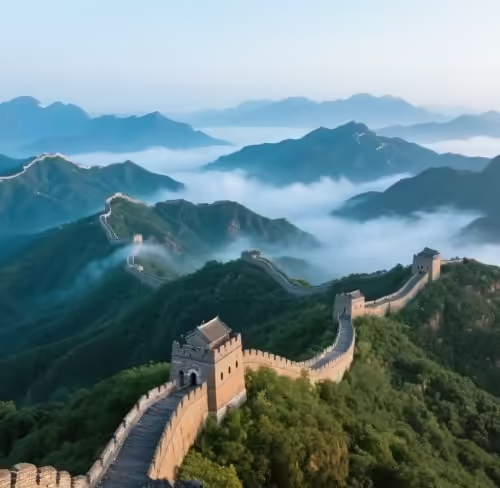
The Mutianyu Great Wall is the second most famous section of the Great Wall after Badaling. It was first constructed during the Northern Qi Dynasty (550–577 CE), renovated in the Ming Dynasty, and later repaired multiple times. The total length is approximately 5,400 meters. Compared to the Badaling Great Wall, Mutianyu attracts fewer visitors, making it ideal for photography enthusiasts.
Main Attractions of Mutianyu Great Wall:
Zhengguantai (three adjacent towering enemy towers).
Da Jiaolou (a building shaped like an "arrow").
Ying Fei Dao Yang (a steep and rugged section of the Great Wall).
Hero Slope (a very steep section of the Great Wall).
Night Tour Projects (including laser projections and guzheng performances; movie screenings were added in 2025).
Location(To Mutianyu Great Wall): Mutianyu Village, Bohai Town, Huairou District, Beijing, about 73 kilometers from central Beijing.
Opening Hours: Peak Season (March 16 - November 15): Monday to Friday: 7:30 AM – 6:00 PM, Saturday and Sunday: 7:30 AM – 6:30 PM, Off-Season (November 16 - March 15): 8:00 AM – 5:30 PM.
Ticket Price: Approximately 40 CNY per person (including scenic area shuttle bus). A Night Great Wall Tour project was launched in 2025.
Simatai Great Wall(司马台长城)
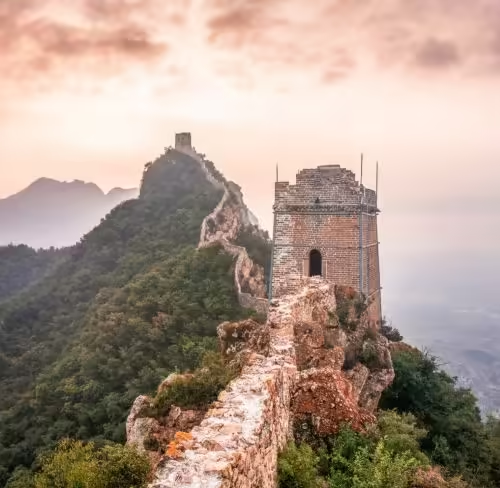
The Simatai Great Wall is one of the most significant sections of the Chinese Great Wall. This section preserves the original form of the Ming Dynasty’s Great Wall, with steep and rugged terrain, and its walls follow the natural undulations of the mountains. It was first constructed during the Northern Qi Dynasty (550–577 CE) and later renovated in the early years of the Hongwu era in the Ming Dynasty (1373), based on the foundations of the Northern Qi Wall. The total length is approximately 5.7 kilometers (some sources state 5.4 kilometers), including 35 watchtowers (with shorter distances between them).
Location(To Simatai Great Wall): Simatai Village, Gubeikou Town, in the northeastern part of Miyun District, Beijing, is about 120 kilometers from central Beijing (approximately 1.5–2 hours by car).
Jiankou Great Wall(箭扣长城)
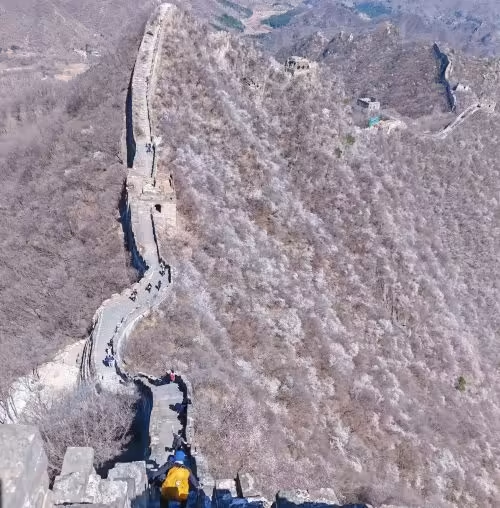
The Jiankou Great Wall is one of the most rugged sections of the Chinese Great Wall. First built during the Ming Dynasty, it has an elevation of 1,141 meters and is a popular destination for photography enthusiasts and adventure seekers. Its shape resembles a drawn bow (in a W-shape), hence the name Jiankou Great Wall.
Location(To Jiankou Great Wall): Within Baduhe Township in the northwest of Huairou District, Beijing, near Xigazicun Village, Yanqi Town, about 100 kilometers from central Beijing (approximately 2 hours by car).
Jinshanling Great Wall(金山岭长城)
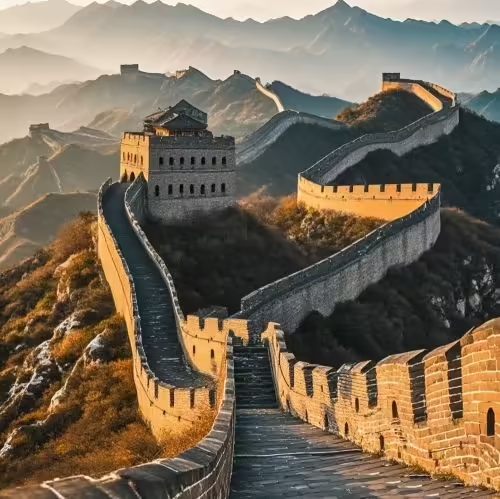
The Jinshanling Great Wall is a World Cultural Heritage Site and a national 5A-level Tourist Attraction, with broad views and densely arranged enemy towers. It was originally built in the first year of the Hongwu era in the Ming Dynasty (1368), with a total length of 10.5 kilometers, stretching from Longyu Kou in the west to Wangjing Lou in the east. In the first year of the Longqing era (1567), it was reconstructed under the leadership of the renowned anti-Wokou general Qi Jiguang.
Location(To Jinshanling Great Wall): Within Luanping County, Chengde City, Hebei Province, adjacent to Miyun District, Beijing, about 130 kilometers from central Beijing.
Jiayuguan Great Wall(嘉峪关长城)
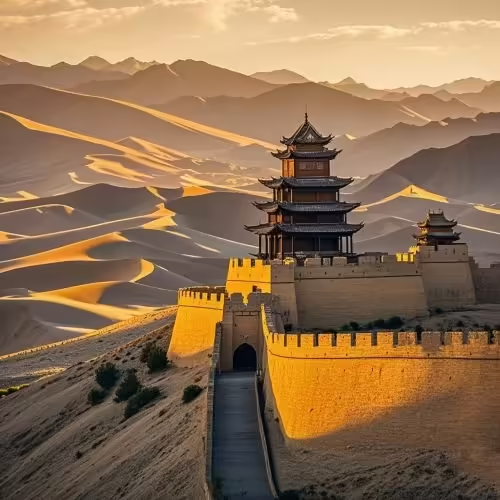
The Jiayuguan Great Wall is the western starting point of the Ming Dynasty’s Great Wall, renowned as "the First Impregnable Pass under Heaven". It was originally built in the fifth year of the Hongwu era in the Ming Dynasty (1372), with a total length of 60 kilometers. It was designated as a National Key Cultural Relics Protection Unit in 1961 and listed as a World Cultural Heritage Site in 1987.
Location(To Jiayuguan Great Wall): No. 421, Chengnan Road, Jiayuguan City, Gansu Province, about 4.5 kilometers from the city center.
Shanhaiguan Great Wall(山海关长城)
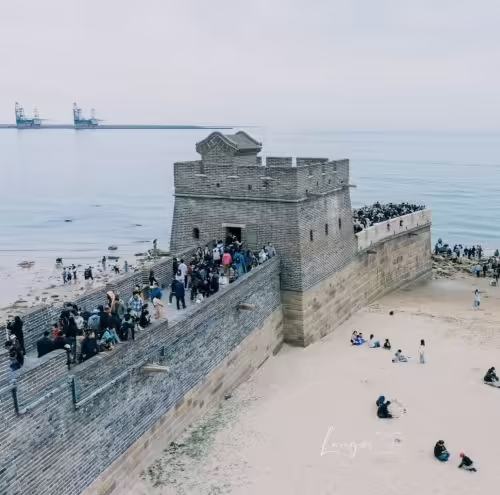
The Shanhaiguan Great Wall is the northeastern starting point of China's Ming Dynasty Great Wall. It was originally built in the 14th year of the Hongwu era during the Ming Dynasty (1381) and has a total length of approximately 26 kilometers. It was damaged during the Republic of China era due to wars and natural disasters, and was restored around 1980.
Location(To Shanhaiguan Great Wall): No. 1, East Street, Shanhaiguan District, Qinhuangdao City, Hebei Province. It is located about 23.8 kilometers from Qinhuangdao.
Yumen Pass Great Wall(雁门关长城)
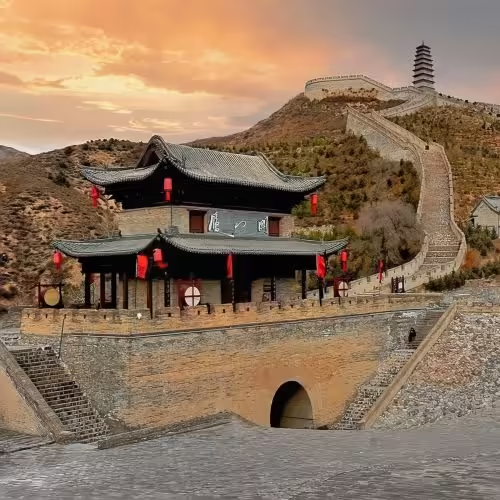
The Yumen Pass Great Wall is an outstanding representative of China's ancient military defense system. It has undergone reconstructions across multiple dynasties, with an elevation of around 2,000 meters and a total length of approximately 5,033 meters. It was designated as a Major National Cultural Protection Site in 2001, recognized as part of the World Cultural Heritage, and rated as a 5A-level scenic area in 2014.
Location(To Yumen Pass Great Wall): Approximately 20 kilometers north of Dai County, Xinzhou City, Shanxi Province, and about 50 kilometers from Xinzhou City.
Important Notes for Visiting the Great Wall
- Some sections of the Great Wall see very few visitors and have fallen into disrepair, posing a high risk of collapse. For example: Jiankou Great Wall (Extremely Dangerous): Many sections are built on sheer cliffs, requiring hand- and foot-climbing. The bricks and stones are severely weathered, increasing the risk of loosening or collapse. This is a high-risk area for accidents. Simatai Great Wall (Relatively Dangerous): Some undeveloped sections feature narrow walls with deep precipices on both sides and no guardrails.
- Great Wall Sections with Access Restrictions: If an area displays “No Entry” signs, do not enter without authorization.
- We recommend wearing non-slip shoes, comfortable sneakers, or professional hiking boots. Some sections are steep and accident-prone.
- Winds are strong on the ridge. In summer, we advise wearing sunglasses, sun-protective clothing, and a hat. In winter, wear a down jacket and warm boots.
- Do not look around while walking. Stop if you want to admire the scenery.
- Rest when tired—don't push yourself.
- Keep identification documents readily available.
- Food on the Great Wall is expensive; bring your own snacks.
- Some areas have poor cell reception—download offline maps beforehand.
- Translation apps are essential.
- Do not damage the Great Wall—it is illegal.
The Current State of the Great Wall
Having endured over 2,000 years of weathering and human destruction, many sections of the Great Wall now lie in ruins. Only a few restored segments—such as Badaling, Mutianyu, and Jiayuguan—are currently open to visitors. The Chinese government and the public are actively engaged in repairing and reinforcing the Great Wall.
The Great Wall is not merely a military fortress; it is a weighty historical tome that has witnessed over two millennia of profound changes in China. It stands as a symbol of the enduring vitality of Chinese civilization.